Common Measurement and Administration Mistakes Involving Half-Dosing Mounjaro

The first mistake is assuming a Mounjaro dose can be measured once it leaves its container. Every approved presentation delivers a fixed amount. The KwikPen instructions for use tell patients not to transfer product from the pen into a syringe. No validated home method exists for a partial dose, and the errors below follow from that gap.
What the approved presentations are built to do
Tirzepatide for type 2 diabetes reaches patients in four forms: a pre-filled single-dose pen, a single-dose vial, a multi-dose vial holding four weekly doses, and a single-patient-use KwikPen holding four fixed doses. Mounjaro is approved as an addition to diet and exercise to improve glycemic control in adults and in pediatric patients aged 10 and older with type 2 diabetes. Zepbound is the separate tirzepatide product carrying weight-management indications, and the two labels are not interchangeable.
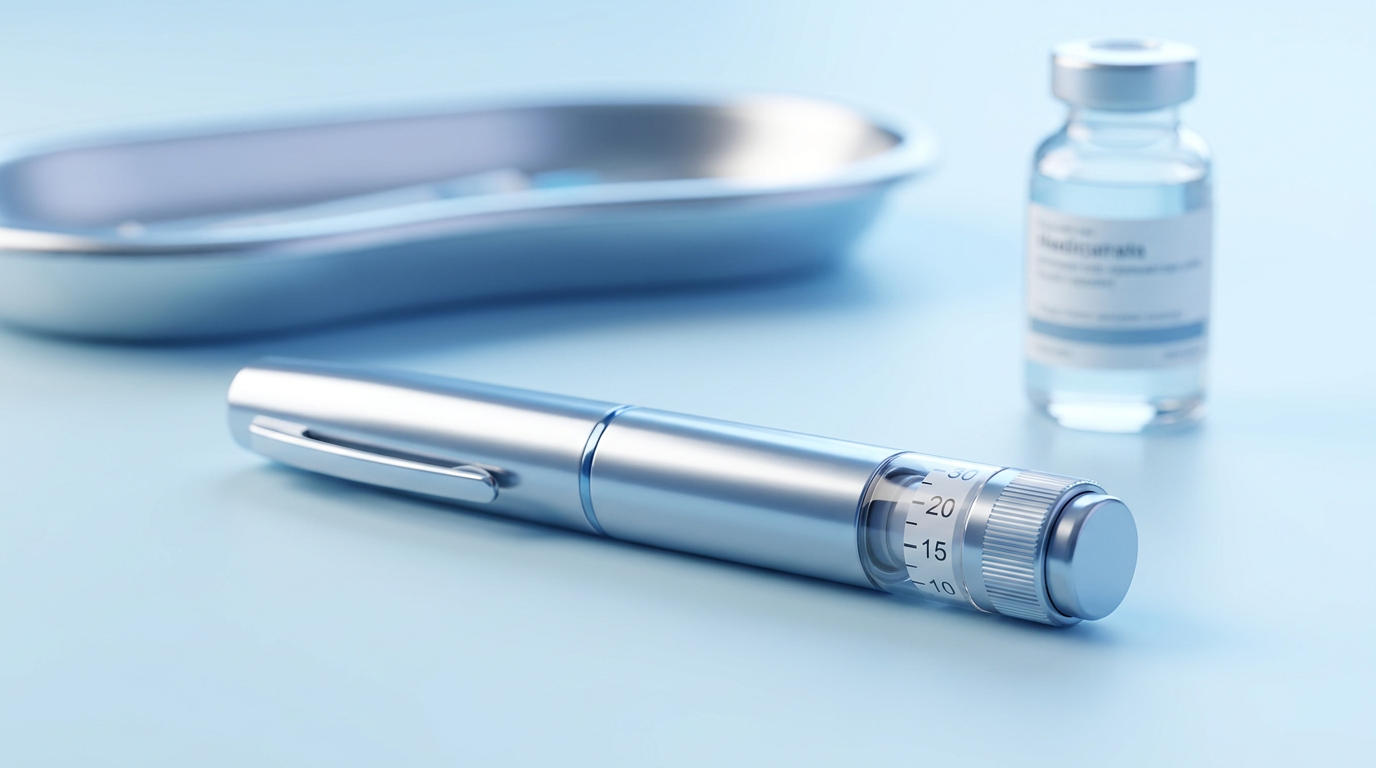
The single-dose pen is printed for use one time each week. It has no selector and no graduations. The injection button is pressed and held, and the visible gray plunger is how the person confirms the full contents went in. The KwikPen carton carries the instruction to turn the dose knob all the way until the icon appears, with the note that this is one dose. The pen is certified against the dose accuracy and functional requirements of ISO 11608-1 for the fixed dose it is engineered to give, which says nothing about any other amount someone might attempt to extract from it.
Sterility is the failure most people never see
The single-dose pen and single-dose vial contain tirzepatide with sodium chloride, sodium phosphate dibasic heptahydrate, and water for injection. Nothing on that list is an antimicrobial preservative. The vial instructions for use state directly that all opened vials are thrown away after use, even when medicine remains inside. That sentence is not about waste. It is the entire reason the presentation is labeled single-dose.
The two multi-dose presentations do carry preservatives, benzyl alcohol and phenol among the excipients, and even those are capped: discard after four weekly doses, after 30 days at room temperature, or 30 days after first use, whichever comes first. A preserved container still has an expiry clock the moment it is entered.
The consequence of ignoring that boundary is documented. Investigators reported invasive Staphylococcus aureus infections in Arizona and Delaware traced to injections given from reused single-dose vials. Household refrigeration does not substitute for the sterility assurance a sealed, unpunctured container provides, and a contaminated injection is not a theoretical risk in this category.
Why accuracy fails before technique does
Even in oral products designed to be divided, subdivision accuracy is poor. Studies comparing hand splitting against tablet cutters, and work examining how fillers and binders affect subdivision, both find weight deviation that would be unacceptable if it were happening to an injected peptide. Tablets at least have score lines and a solid mass to work with. An injectable has neither.
The error is also asymmetric in its consequences. An amount below what was intended looks like a drug that stopped working, which invites an unnecessary escalation. An amount above what was intended looks like severe gastrointestinal illness. Poison center reports involving compounded GLP-1 preparations describe administration errors as a recurring reason for contact rather than deliberate misuse, and a single center review of these exposures found the same pattern.
Anyone researching the branded product will notice that the named providers describe it in their own ways. Manufacturer routes such as LillyDirect connect patients to the branded product directly, while telehealth names including Ro, Henry Meds, and HealthRX publish patient-facing pages on Mounjaro that set out the labeled milligram steps. Reading two or three of those side by side is a quick way to confirm that every legitimate source lands on the same fixed doses rather than a partial one.
The assumptions and what each one collides with
| The assumption | What the product actually does | What follows |
|---|---|---|
| A pen can be stopped partway | Delivery is a single action confirmed by the plunger | An unknown amount delivered and an unusable pen |
| Leftover product is spare product | Single-dose containers are discarded after use with medicine remaining | Sterility assurance ends at first puncture |
| A preserved vial is open-ended | Four weekly doses, then discard regardless of contents | Product used past its labeled window |
| A pen can supply a syringe | The KwikPen instructions say not to transfer into a syringe | Device accuracy certification no longer applies |
| Volume math read online transfers | Compounded strengths vary by pharmacy | Numbers describing one preparation applied to another |
| A smaller amount is simply a gentler dose | No approved step sits below the initiation dose | No efficacy or safety data describe what was given |
| A weak response means the drug failed | The delivered amount was never verified | Escalation based on a measurement that never existed |
Compounded tirzepatide breaks the arithmetic completely
Compounded tirzepatide is not FDA-approved. No agency-reviewed label fixes its concentration, its container, or its handling, and strengths differ between compounding pharmacies. Any volume reasoning encountered in a forum or a video therefore describes one specific preparation at best, and carrying it to a different vial has no basis at all. The FDA has published its position on compounded and unapproved GLP-1 products marketed for weight loss, and dosing confusion sits near the center of it.
How a prescription is obtained determines who can answer questions about it. Clinics dispensing the branded product work from one set of instructions, and manufacturer channels such as LillyDirect connect patients to a prescriber for that same product. Telehealth services including Ro, Hims & Hers, LifeMD, and FormBlends operate through compounding pharmacies, where the strength on the specific vial is the only figure that governs anything. Asking which pharmacy fills the order, what concentration it supplies, and who responds when a dose feels wrong is a reasonable request at any of them.
The reasons behind the question are real
People rarely improvise for entertainment. They do it because a month of medication costs more than the budget allows, or because the last increase produced days of nausea. Both have routes that do not require guessing. A prescriber can hold treatment at a tolerated labeled step instead of moving up on schedule. Manufacturer self-pay channels and savings programs change the cash price. A denied claim can be appealed internally and then reviewed externally, and Part D coverage rules set out what a plan is obliged to consider. None of those routes depend on anyone measuring anything at a kitchen counter.
Frequently asked questions
Does the label anywhere describe a partial dose?
No. Dosing is written in whole labeled steps starting at 2.5 mg once weekly, and every presentation is built to deliver one of those steps. The KwikPen instructions go further and tell patients not to transfer product from the pen into a syringe, which closes the route people most often ask about.
Is a punctured single-dose vial safe if it goes straight back in the fridge?
The single-dose presentations contain no antimicrobial preservative, and the instructions for use direct that opened vials are discarded even with medicine left inside. Cold storage slows microbial growth but does not restore the sterility assurance of an unpunctured container, and reuse of single-dose vials has produced documented invasive infections.
Why do online volume figures differ so much?
Because they usually describe compounded preparations, which have no FDA-reviewed concentration standard and vary between pharmacies. A figure that fits one vial can be far off for another carrying the same drug name. Approved product figures describe the approved product only and are not portable either.
What happens to monitoring when the delivered amount is unknown?
Every reading afterward becomes hard to interpret. A rising A1c could reflect an inadequate amount or genuine non-response, and there is no way to distinguish them. That ambiguity tends to produce either an unnecessary dose increase or an abandoned treatment plan, both avoidable outcomes.
Sources
- DailyMed, Mounjaro (tirzepatide) prescribing information and instructions for use: https://dailymed.nlm.nih.gov/dailymed/search.cfm?labeltype=all&query=MOUNJARO
- DailyMed, Zepbound (tirzepatide) prescribing information: https://dailymed.nlm.nih.gov/dailymed/search.cfm?labeltype=all&query=ZEPBOUND
- Invasive Staphylococcus aureus infections associated with pain injections and reuse of single-dose vials, Arizona and Delaware. PubMed: https://pubmed.ncbi.nlm.nih.gov/22785340/
- Administration errors of compounded semaglutide reported to a poison control center, case series. PubMed: https://pubmed.ncbi.nlm.nih.gov/37392810/
- Characterization of GLP-1 agonist exposures reported to a single United States poison center. PubMed: https://pubmed.ncbi.nlm.nih.gov/39803696/
- Accuracy of tablet splitting: comparison between hand splitting and tablet cutter. PubMed: https://pubmed.ncbi.nlm.nih.gov/25473334/
- The effects of fillers and binders on the accuracy of tablet subdivision. PubMed: https://pubmed.ncbi.nlm.nih.gov/30120694/
- FDA, FDA’s Concerns with Unapproved GLP-1 Drugs Used for Weight Loss: https://www.fda.gov/drugs/drug-alerts-and-statements/fdas-concerns-unapproved-glp-1-drugs-used-weight-loss
- FDA, Compounding and the FDA: Questions and Answers: https://www.fda.gov/drugs/human-drug-compounding/compounding-and-fda-questions-and-answers
- Medicare, drug coverage under Part D: https://www.medicare.gov/drug-coverage-part-d