The Silent Engineering Power Behind a Laser Welding Machine Manufacturer in Modern Industrial Transformation

Manufacturing has entered a phase where accuracy is no longer a luxury but a fundamental requirement. Industries that once depended on traditional welding methods are now shifting toward advanced laser-based solutions that deliver cleaner, faster, and more controlled results. This shift is not just about improving production speed, but about redefining how materials are joined, how structures are built, and how industrial reliability is achieved.
At the center of this transformation stands the role of a laser welding machine manufacturer, an entity that does far more than assemble machines. It designs precision systems that shape the future of automotive production, electronics manufacturing, aerospace engineering, medical device fabrication, and even micro-scale industrial assembly.
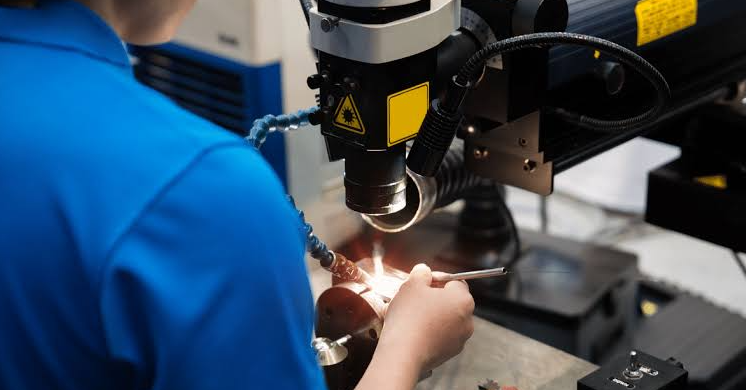
Unlike conventional welding systems that rely on heat diffusion through direct contact, laser welding uses highly concentrated energy beams to fuse materials with extreme accuracy. This allows manufacturers to achieve strong, clean, and consistent welds with minimal distortion. However, the real value of this technology depends heavily on how well the system is engineered at the manufacturing stage.
In modern industry, performance begins long before the machine reaches the factory floor.
The Shift From Conventional Welding to Precision Laser Systems
For decades, industries relied on MIG, TIG, and arc welding processes to join metals. While these methods were effective, they often introduced challenges such as excessive heat zones, material deformation, and inconsistent joint quality.
As product designs became more complex and tolerances became tighter, manufacturers began searching for alternatives that could deliver more controlled energy application. Laser welding emerged as a solution capable of meeting these demands.
By focusing energy into a narrow beam, laser welding minimizes heat-affected zones and creates precise, deep, and clean welds. This level of control is particularly important in industries where even microscopic imperfections can lead to structural or functional failure.
The transition from traditional welding to laser technology represents more than a tool upgrade. It represents a fundamental shift in manufacturing philosophy.
See also: IPTV Suppliers Canada: Ranked 2026
The Core Responsibility of a Laser Welding Machine Manufacturer
A laser welding system is not just a machine. It is a combination of optical engineering, thermal control, motion precision, software integration, and industrial safety systems working together.
A laser welding machine manufacturer is responsible for designing this complex ecosystem in a way that ensures stability, accuracy, and long-term durability. Every component, from the laser source to the beam delivery system and cooling mechanism, must work in perfect synchronization.
Unlike simple mechanical equipment, laser welding systems require deep expertise in physics, materials science, and automation engineering. The manufacturer’s role is to convert this technical knowledge into reliable industrial solutions that can operate continuously in demanding environments.
This makes the manufacturer not just a supplier of equipment, but a creator of industrial capability.
Why Precision Defines Modern Manufacturing Success
Today’s manufacturing environment is defined by precision requirements that were unimaginable a few decades ago. Products are becoming smaller, more complex, and more performance-sensitive.
In industries such as electronics and medical devices, even a minor deviation in welding quality can affect product functionality. This is why laser welding technology has become essential for high-precision production lines.
Laser welding machines enable manufacturers to achieve repeatable accuracy with minimal variation across thousands of production cycles. This consistency is one of the key reasons why industries are rapidly adopting this technology.
Precision is no longer just an advantage. It is a requirement for survival in competitive markets.
Engineering Complexity Behind Laser Welding Systems
While laser welding appears simple from the outside, the internal engineering behind it is highly complex. It involves advanced optical alignment systems, real-time thermal control, motion synchronization, and intelligent feedback mechanisms.
A well-designed system must maintain beam stability under varying operational conditions. It must also ensure that heat distribution remains controlled to prevent material damage or structural weakness.
This level of engineering precision is what separates basic equipment from industrial-grade manufacturing systems.
Manufacturers who invest in advanced design capabilities are able to deliver machines that perform reliably under continuous industrial load.
The Role of Automation in Laser Welding Evolution
Modern industrial systems are increasingly automated. Manual processes are being replaced by robotic systems that can operate continuously with minimal human intervention.
Laser welding fits naturally into this ecosystem because it can be easily integrated with robotic arms, CNC platforms, and smart factory control systems.
Automation allows manufacturers to achieve higher production rates while maintaining consistent quality. It also reduces human error and improves workplace safety by minimizing direct exposure to high-energy welding environments.
A forward-thinking laser welding machine manufacturer designs systems that are compatible with these automated environments, ensuring seamless integration with Industry 4.0 technologies.
Material Versatility and Industrial Applications
One of the strongest advantages of laser welding technology is its ability to work with a wide range of materials. From stainless steel and aluminum to titanium and specialized alloys, laser systems can handle diverse industrial requirements.
This versatility has made laser welding essential in industries such as automotive manufacturing, aerospace engineering, energy systems, battery production, and precision electronics.
Each application requires different levels of energy control, penetration depth, and beam stability. A well-engineered system must be adaptable enough to handle these variations without compromising performance.
This adaptability is a key factor in modern manufacturing success.
Efficiency and Cost Optimization in Production
Beyond precision, laser welding technology also contributes significantly to production efficiency. Traditional welding methods often require additional finishing processes due to spatter, distortion, or uneven joints.
Laser welding reduces or eliminates many of these post-processing requirements, leading to faster production cycles and lower operational costs.
Energy efficiency is another important factor. Laser systems concentrate energy precisely where it is needed, reducing waste and improving overall system efficiency.
Over time, these improvements contribute to significant cost savings for manufacturers.
Why Reliability Matters in Industrial Environments
Industrial production systems often operate continuously for long hours under demanding conditions. Any interruption can result in production delays and financial losses.
Reliability is therefore one of the most important characteristics of any welding system.
A well-engineered laser welding machine is designed to maintain stable performance even under extended operational cycles. Proper thermal management, high-quality optical components, and robust system architecture all contribute to long-term reliability.
Manufacturers that prioritize durability and system stability help industrial users maintain uninterrupted production flow.
The Future of Laser Welding Technology
As industries continue evolving toward greater automation and digital integration, laser welding technology is expected to become even more advanced.
Future systems are likely to incorporate artificial intelligence for process optimization, real-time monitoring for quality control, and adaptive beam control for complex materials.
These advancements will further increase precision while reducing human intervention in production processes.
The role of the laser welding machine manufacturer will continue to evolve as well, shifting toward intelligent system development and integrated manufacturing solutions.
Conclusion
Laser welding technology represents a major advancement in modern industrial manufacturing. Its ability to deliver precise, efficient, and reliable welding solutions has made it essential across a wide range of industries.
However, the true value of this technology is determined not only by its application but by the engineering expertise behind it.
A laser welding machine manufacturer plays a critical role in shaping industrial performance by designing systems that combine optical precision, automation compatibility, and long-term reliability.
As manufacturing continues to move toward smarter and more automated systems, laser welding will remain a key technology driving innovation, efficiency, and industrial transformation.